Exploring Yaf Keru – ‘Travelling with The SEA People in West Papua teaches many things, including that coral restoration is hard work.’
Travelling with The SEA People in West Papua teaches many things, including that coral restoration is hard work.
Day Ten:
I’m awake at 2:30. I hear loud talking coming from the village across the water and the occasional song. It’s like someone has turned the volume up to 11. I imagine the guy is saying … “the place that rocks, the place that never stops … this is RADIO PAPUA”! I’m sure he’s not.
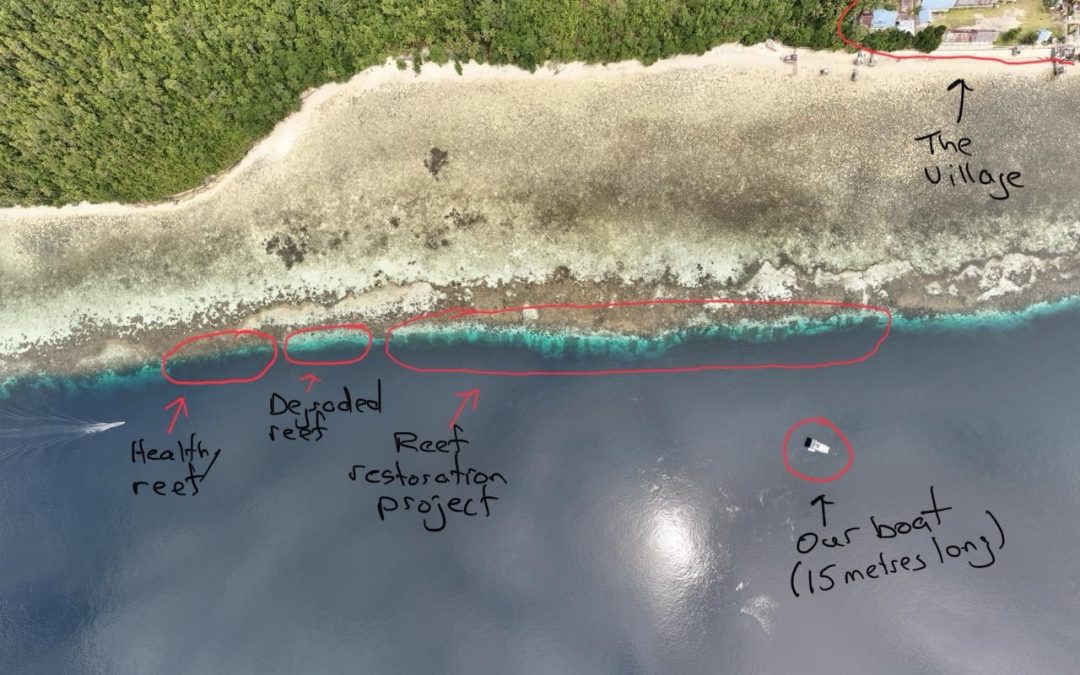
We’re moored opposite The SEA People’s main reef restoration site. I’ve been reading and hearing about it for years and I’m keen to finally see it in the water.
On the first dive Arnaud guides me across the 4 hectare site. I’m stunned. There’s thousands of hours of hard work in what I’m seeing.
Cyanide fishing, people mining coral for building foundations and a thousand other things have created rubble slopes devoid of life. They’re threatening to run over the top of pristine reef deeper down.
Where The SEA People have laid mesh and transplanted coral the plants and animals of the reef return. You can draw a straight line of life between the restored and unrestored sections. And so much is restored. We dive for an hour but don’t get from one end to the other.
The second dive I go off with Yos and Piet to transplant loose coral fragments by taking them from the rubble and securing them to the steel mesh they’ve laid. They give me an excellent pre-dive briefing with a mix of Bahasa, English, hand signals and drawings. I think I know what’s required. Apparently my goal is 100 coral transplantations per session.
We work for about 70 minutes and by the time we’re done, we’ve transplanted 101 coral fragments. For the first time ever, I feel like I’ve made some small positive contribution to the marine environment here.
At the end of the dive we get together and complete an online report which is immediately uploaded and much of it made publicly available. I like the fact that irrespective of whether their results over time with restoration are good or bad, it all gets reported.
In the last light of the day I’m reflective. There have been a few references here to me being the son of a great man. I’m not sure how it sits with me.
My father was a marine biologist and produced a pretty famous book suggesting western science might not have all the answers. He thought we could learn from indigenous fishers about the marine environment they’d been observing for thousands of years. So in the 70s we went to live in a traditional Palauan fishing village and afterwards he wrote his Words of the Lagoon. Heresy in its time.
I think he’d be pleased I’m here seeing what I’m seeing, and saying what I’m saying.
Then a whale quietly passes by and snaps me out of my self-indulgence.
Source: LinkedIn | Greg Johannes
Photo: Greg Johannes
Past Entries:
About The Author: Greg Johannes, Ambassador – The SEA People. Greg spent 2 weeks aboard the Galaxea with us and documented his experience in his daily entries into ‘The SEA People Diaries’.
Day Nine – Read here
Day Eight – Read here
Day Seven – Read here
Day Six – Read here
Day Five – Read here
Day Four – Read here
Day Three – Read here
Day One and Two – Read here
Day Zero – Read here