
Papuan echidnas and black tree kangaroos, a beautiful village and very strong currents, and the most developed part of Raja Ampat.
We’re moving on today. Obaja is dancing around the back of the boat to the local music he plays and the atmosphere is pretty chilled. I learn how to say “can I help with anything” in Bahasa. As usual, I’m about as useful on a boat as a fire in the engine room.
After successfully navigating Galaxia’s low ceilings the inevitable happens and I cut my head. The only surprise is that it’s taken nine days.
Over coffee Lynn talks with Yos about her village. Leatherbacks are nesting there now and there are Papuan echidnas and black tree kangaroos. They ask if I want to change my flights and stay … just a little longer. I’ve always believed you should leave a place wanting more.
The day is low key. When the chop brings me close to sea sickness I sleep it off and we stop once along the way to pick up fresh supplies. Work inevitably intrudes when we pick up signal and three of us madly tap away around the galley table at the first sign of a bar on our phones.
We arrive at Yenbekwan late in the afternoon.
Three things immediately strike me as we attach to The SEA People’s mooring.
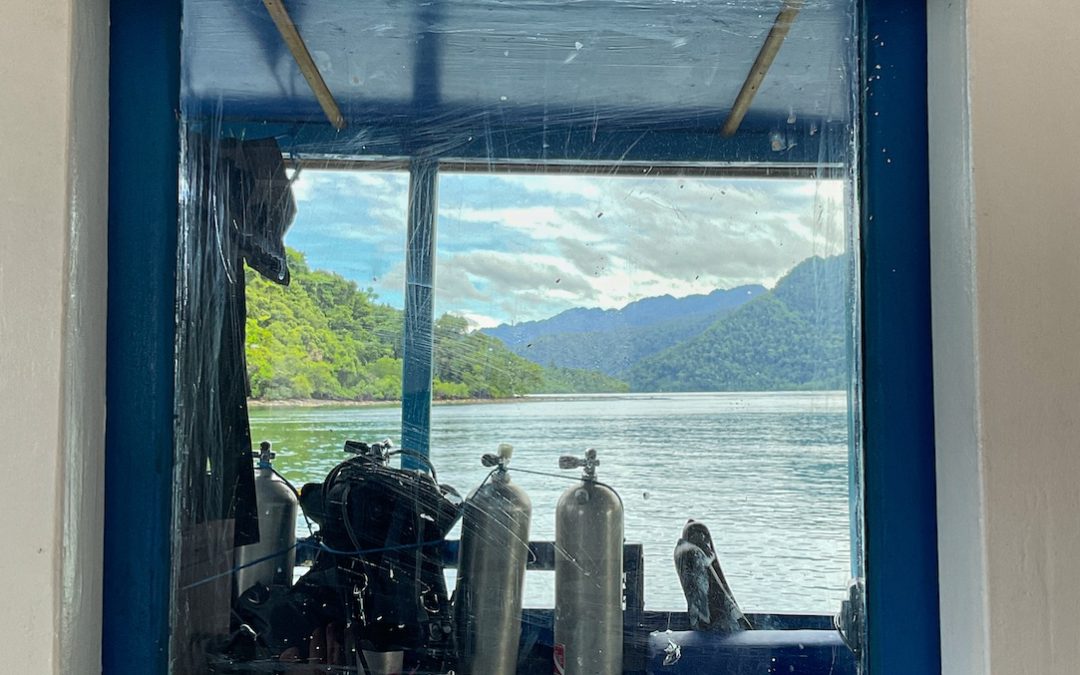
Firstly, this village is set beautifully. As they so often do around here, a three story church dominates a one story skyline. It sits at the base of a steep forested hill behind jade green waters which roll on to a long, white sandy beach.
Secondly, the current rips through. Our mooring line is attached to freezers full of cement 43 metres down but still looks like it’s straining to hold on, and Piet does an incredible job to secure our ropes when he dives in with nothing more than a mask. If I tried the same thing I’d use giant fins and a snorkel, and I’d still fail the job and soon be drifting off into the blue.
Thirdly, there is rubbish floating everywhere. Plastic bottles. Disposable noodle cups. Styrofoam. Everywhere.
And this is really no surprise. In this part of the world there’s no recycling centre, or local land-fill and re-use shop. There’s no waste incinerator. There’s just piles and burning. So every time the wind blows or the rain falls and turns into runoff, there’s only one place for the trash to go.
As always though, it’s not that simple. This isn’t just their rubbish. It’s our rubbish too. Plastic bottles don’t respect jurisdictional boundaries and there’s a good chance I’m seeing some stuff that, just like me, floated in from overseas.
The rubbish is soon lost to the night and I realise there are lots of little sets of glowing dots on the horizon where there weren’t the eight days before. We’re now in the Dampier Strait, the most developed part of Raja Ampat thanks to tourism. I expect a very different reef experience over the next few days.
Source: LinkedIn | Greg Johannes
Photo: Greg Johannes
Past Entries:
About The Author: Greg Johannes, Ambassador – The SEA People. Greg spent 2 weeks aboard the Galaxea with us and documented his experience in his daily entries into ‘The SEA People Diaries’.
Day Eight – Read here
Day Seven – Read here
Day Six – Read here
Day Five – Read here
Day Four – Read here
Day Three – Read here
Day One and Two – Read here
Day Zero – Read here