
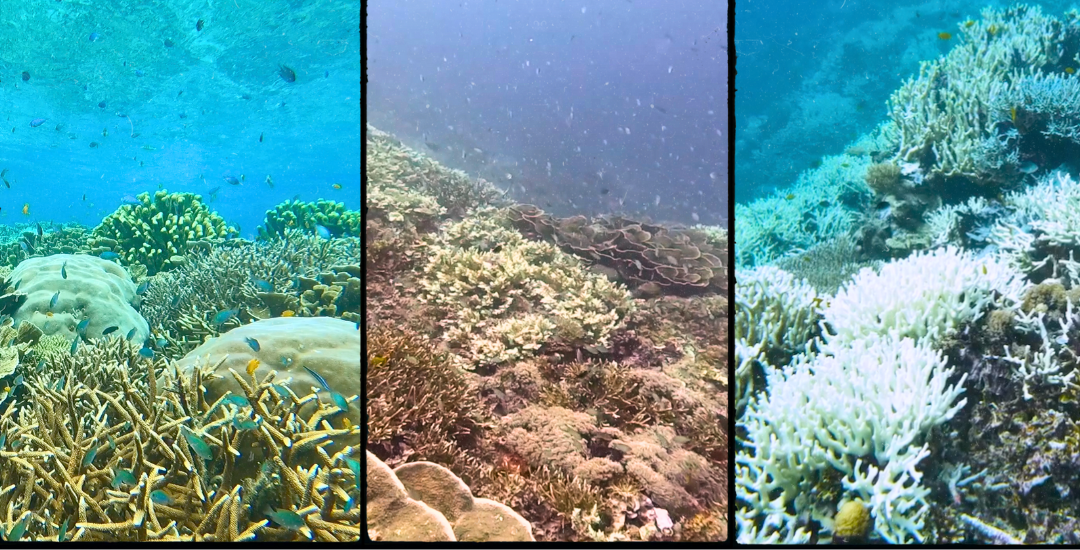
Like many coral reefs regions around the world right now, Raja Ampat is experiencing the impacts of a record-breaking marine heatwave, resulting in a coral bleaching. This aligns with broader climate patterns (El Nino), human induced climate change (which has brought about the world’s Fourth Global Bleaching Event) and the associated rising global ocean temperatures, combined with varying levels of localised pressures.
We are publishing this story now, based on our observations and those of others who’ve been diving throughout Raja Ampat, within the Dampier Strait and beyond. And as always with Raja Ampat, variance and diversity reign (as can be seen in the video below). With this article, we do not claim to give a definitive report on the condition of every reef in the region – this is impossible – but rather, we aim to communicate and clarify some key points about bleaching in general, bleaching in Raja Ampat, and how we can support those reefs that are suffering until the colder water arrives, giving them the best chance of recovery and survival.
Video Credits: Lynn Lawrance, Cory Patty, Yosina Padwa, Tim Noack, Arnaud Brival, Jakare Liveaboard
The Facts
Raja Ampat covers a vast area of over 4.5 million hectares; and it is impossible for anyone to say definitively that “Raja Ampat is bleached”.
The situation is complex: some corals are fully bleached, others stressed, and many remain healthy, even thriving. What we’ve shown in this video is from a series of dives taken within the past couple of weeks, clearly indicating the variance. Of those corals that are bleached; at time of writing they are still alive (bleached does not mean dead) – having simply expelled the algae that gives them their colour; these bleached corals are actively feeding on the abundant plankton in Raja Ampat’s rich waters.
At present, the most famous and frequented sites within in the Dampier Strait appear to be among the most affected by bleaching. However, this observation comes with subjectivity and potential bias, particularly as other areas are less frequently visited or monitored; (eg: there are no reports of bleaching at sites where nobody visits).
The extent of the current bleaching event is alarming and should be taken very seriously, and we do not wish to downplay this; but it is important to note that the current variability and ‘patchwork’ of bleaching impact also reflects both the vulnerability and the extraordinary resilience of Raja Ampat’s coral reefs. To date, these reefs have demonstrated an incredible ability to recover from bleaching events, including those in 2016/2017 and 2021—events that, unless you were here at the time, you would not know occurred at all due to the low levels of mortality.
This incredible resilience can be attributed to several unique ecological dynamics (healthy populations of grazing fish, strong currents and deep-water upwellings, shallow inlets and creeks that act as natural “training grounds” for heat-resistant corals, abundant planktonic food which support corals when their ability to photosynthesize is compromised, full forest/mangrove cover in coastal areas) combined with and a lack of other stressors and pressures (pollution, wastewater, overfishing, coastal development, overtourism).
These factors create robust natural feedback loops that have allowed Raja Ampat’s reefs to bounce back time and time again; where other reefs around the world die off.
But this does not mean we can assume all will be well once again. What this should tell us is that if we do not navigate this with the care and respect that the coral reefs we say we value deserve, there is a lot more to lose.
The current bleaching event is still unfolding, and we don’t yet know its full impact. What is ‘true’ now, my be different in a month or two. What we do know with certainty, is that it serves as a clear warning sign that shouldn’t be ignored.
Coral bleaching is typically a symptom of broader environmental stress. And while global solutions to address climate change may seem beyond reach in the short term, local action is within our control.
The best way to support Raja Ampat’s reefs right now is to reduce and minimise local pressures (such as pollution, wastewater, overfishing, damaging marine activities, overtourism sites suffering bleaching, unchecked and/or careless tourism practices) and safeguard the region’s unique ecological dynamics – which combined have protected it for centuries.
Pressures on coral reefs are cumulative, particularly during a bleaching event; so reducing these pressures – especially in the areas that are suffering from bleaching the most – gives corals the maximum chance of survival and full recovery.
What Now?
Over the years, Raja Ampat’s reefs have proven they can take a hit; but just like the rest of us, there’s a limit to their resilience—and right now, none of us know where that tipping point is. With water temperature expected to start to cooling in 5-8 weeks, but with a Bleaching Alert remaining at Level 1 for another 12weeks (see diagrams below), Raja Ampat’s reefs need every possible advantage we can give them to recover, just like they have in the past.
For individuals, minimizing personal impact is vital. Three of the most significant pressures individuals can help mitigate are:
- Chemical pollution (from sunscreen, body care and homecare/housecare products, leakage/seepage from boats)
- Coral breakage (from fin kicks, trampling, grabbing, poor bouyancy, careless boat manoeuvring)
- Nutrient pollution (yes… this means the cumulative number of poop days in areas experiencing stress!).
Additionally, it’s important to ensure that wetsuits, boots, and fins are thoroughly cleaned to avoid introducing viruses or harmful organisms from other regions.
As the world lives through the Fourth Global Coral Bleaching Event, now is not the time for complacency and the ‘business as usual’ approach; it’s a time for action. With continually rising ocean temperatures and marine heatwaves expected to become more frequent and intense, the window to act may well be closing. Every choice we (not the notorious “they”) make—minimizing pollution, reducing local stressors, and supporting genuine conservation efforts and reducing carbon emissions – will determine whether these reefs can continue to thrive or if they’ll be pushed past their breaking point.
For those who truly care about Raja Ampat – as much as their social media posts say they do – right now, the call to action here is simple:
- Reduce localised pressures (particularly at sites suffering the most)
- Don’t wait for someone else to reduce localised pressures; recognise that the quickest and most impactful actions we can take right now, are those we take ourselves; the slowest are those we wait for others to do on our behalf. WE (not ‘they’) are all part of this; both the problem and the solution.
Nature is often underestimated, but just as often surprises us when left undisturbed. Imagine what would happen if we made a conscious decision to leave an area undisturbed… or more critically, how strong and adaptive it could be if we actually started supporting it?
To close… so far much of the narrative around bleaching in Indonesia and Raja Ampat has been through the lens of tourism; this stands to reason as the industry with the greatest capacity to speak out. But let’s always remember: there was something—and more importantly, someone – here well before tourism began. These people and their communities, whose culture, traditions, history and heritage are deeply intertwined with the health of these reefs, stand to lose far more than the cost of a holiday or the disappointment of visiting guests. Coastal communities in Raja Ampat stand to lose their way of life, their sustenance, and a connection to the ecosystems that have sustained them for generations.
So by all means, come and visit these reefs as guests, but remember to go lightly (walk, dive, snorkel with the greatest of care) to give the reefs the best possible chance of recovering, and surviving.
Coral Bleaching and Yaf Keru
With respect to our reef restoration program, we are NOT transplanting at the moment. Just as there’s no point in planting trees in a forest on fire, we believe there is limited value in transplanting corals during a bleaching event of this intensity. Instead, we are dedicating our time to monitoring, building capacity within local communities, and identifying which coral species are resilient versus those that are not. Whilst we’d prefer not to be in the midst of the Fourth Global Bleaching event… we are using this time to learn what we can, in order to be better prepared for whatever comes next.
PS: Unsurprisingly… there are members of our local team, who’s natural world knowledge can tell us which corals are more ‘heat resilient’… without needing a university degree, lab testing corals, or referring to a data set.
We will update again in early in 2025.
The Fourth Global Bleaching Event: Bleaching Alert Maps
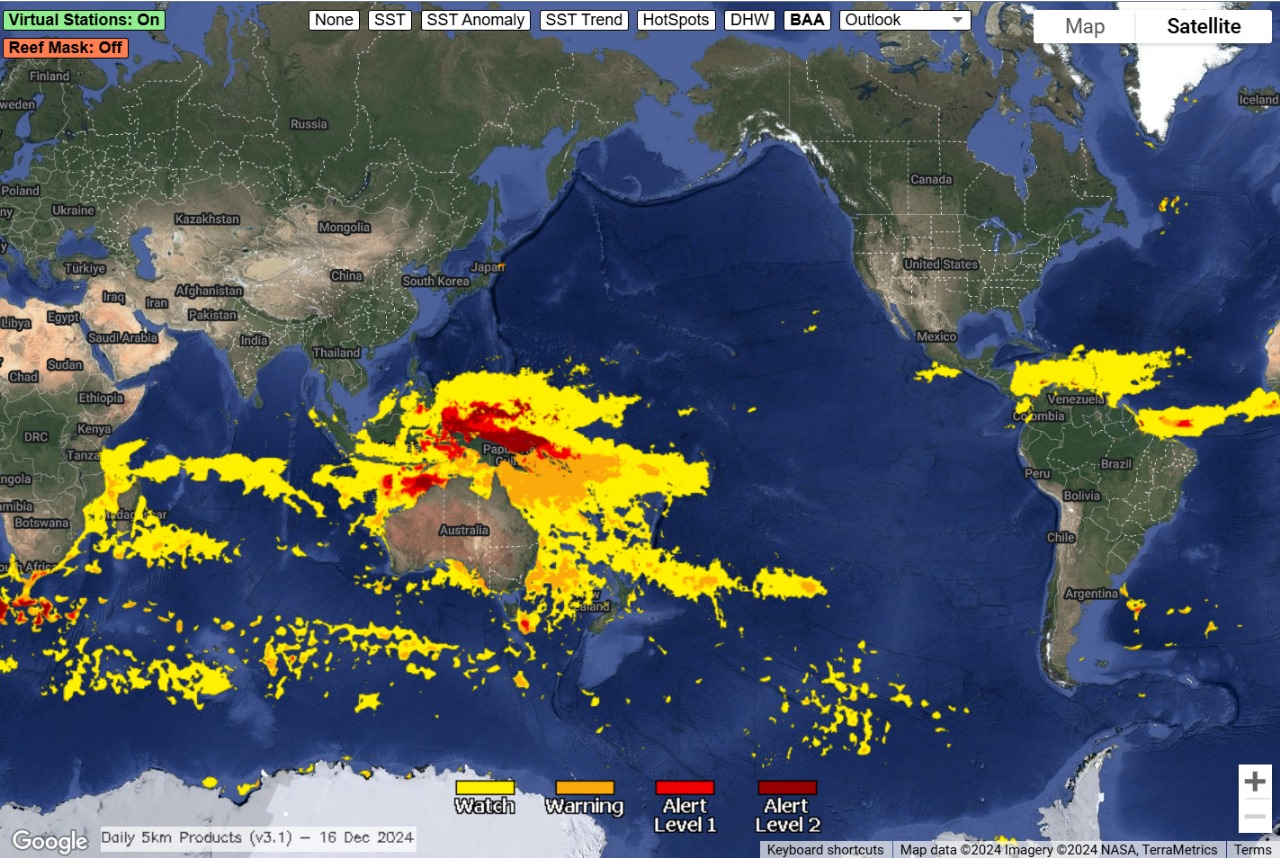
Raja Ampat and the Birdshead Seascape in the middle of Alert Level 2 (highest alert level).
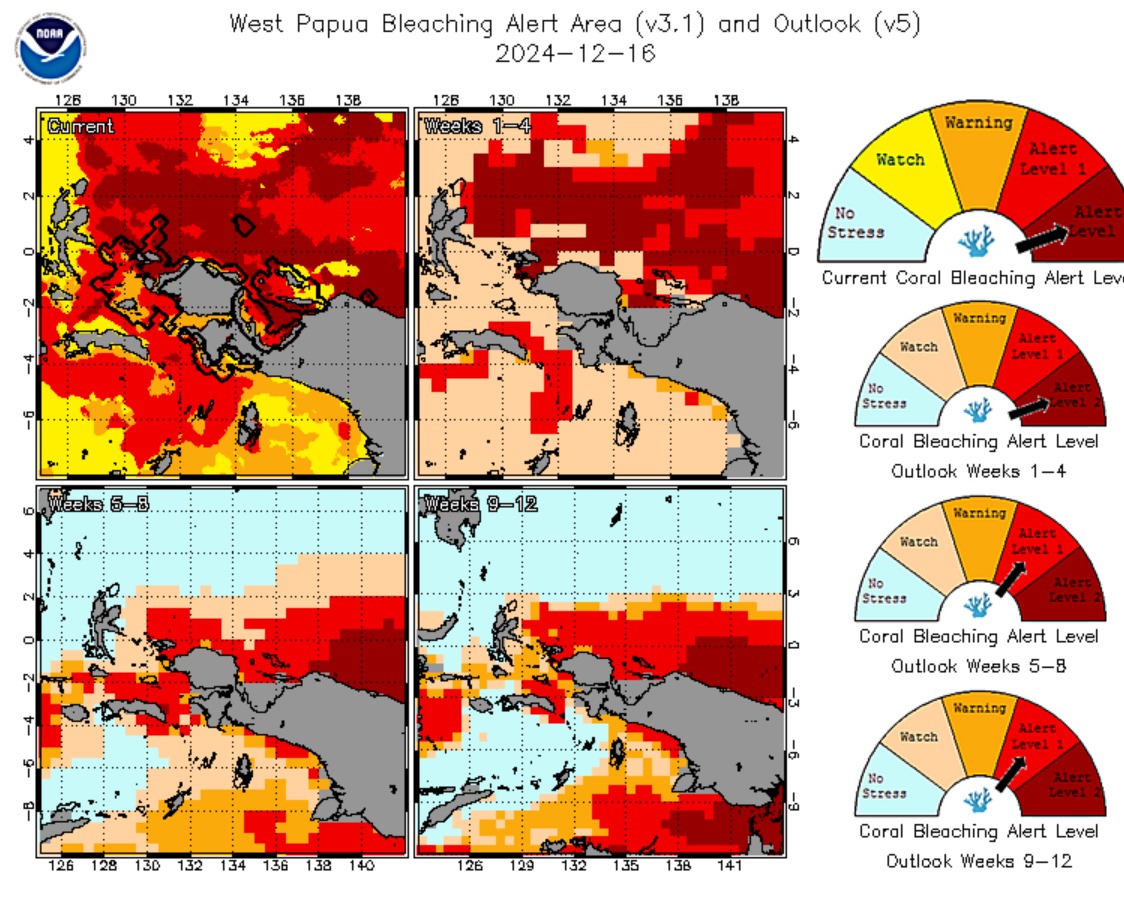
The next 5-12 weeks are critical; whilst water begins to cool within 5-8 weeks, weeks 9-12 remain on Alert Level 1.
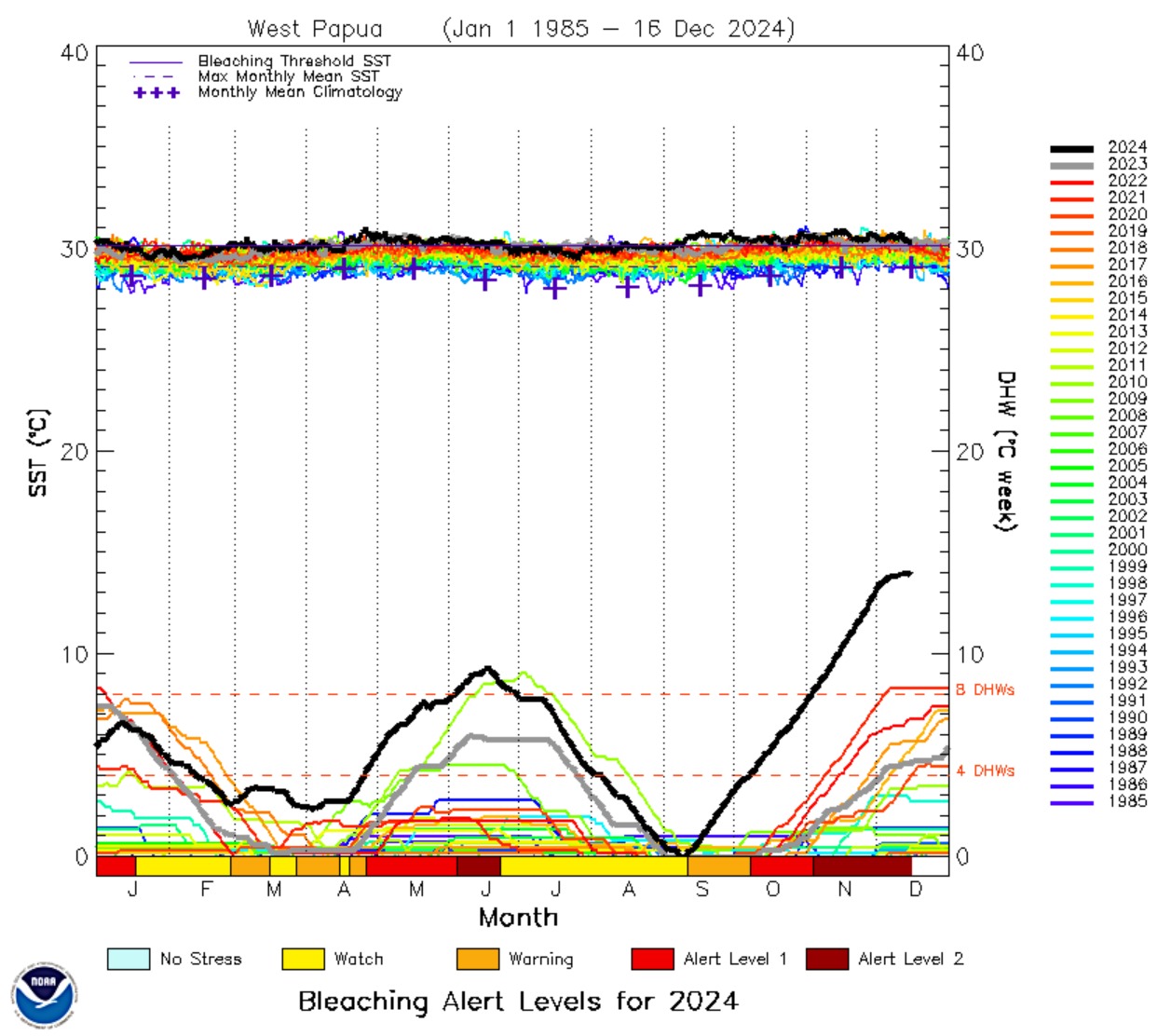
Bleaching Alert Levels for 2024 (black line) indicates the unprecedented speed and severity of the current bleaching event, as compared to previous events.